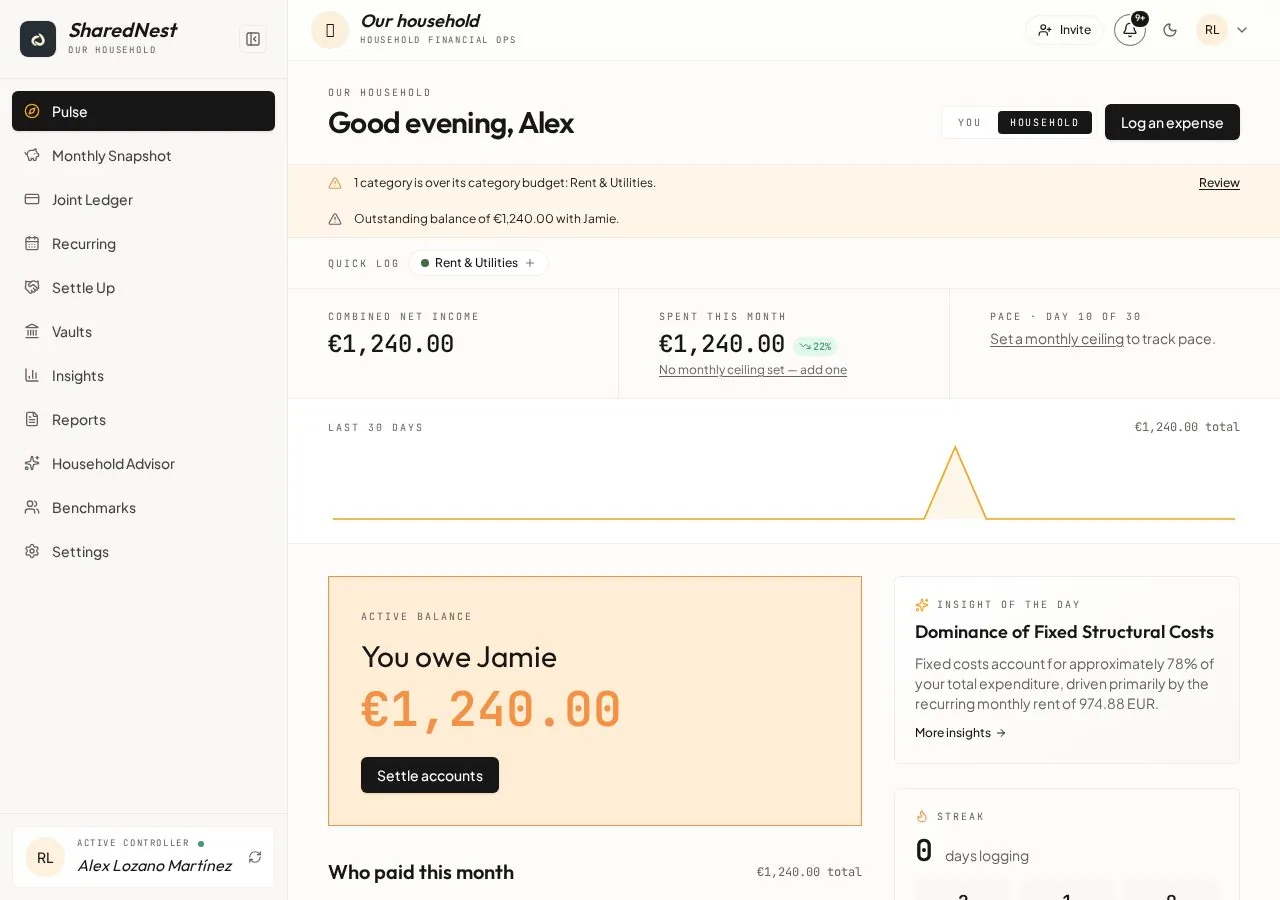
When one person earns €3,200 and the other €1,900, a 50/50 split is not equal — it just looks like it. SharedNest splits every shared expense in proportion to income, so both people feel the same weight.
Pulse brings this month’s position, household balance and next actions into one calm view. Demo data shown.
In short
Income-based splitting divides a shared cost in proportion to each person's income instead of evenly. If one partner earns 60% of the household income, they cover 60% of the shared bill. SharedNest applies that ratio to every expense automatically, corrects rounding to the cent, and still lets you override any single item.
Works in euro, US dollar and pound sterling, with a base currency per household and a display currency per person.
Why does an even split feel unfair when incomes differ?
An even split takes the same number of euros from both people but a very different share of what they have. On a €1,400 rent, €700 each leaves the lower earner with far less breathing room, and that gap compounds every month until it turns into resentment.
Most couples notice the problem long before they name it. One person starts declining dinners out, or quietly puts a bill on a credit card, and the conversation about money becomes a conversation about fairness instead.
Proportional splitting removes the negotiation. Once the ratio is set, it applies to everything shared, and nobody has to argue their case item by item.
How does income-based splitting work in SharedNest?
You enter each person's net monthly income once. SharedNest turns those figures into a percentage ratio and applies it to any expense you mark as shared, showing each person's exact share before you save.
Set the split rule once and it applies to every new shared expense
Override a single expense with a custom split or exact amounts
Rounding is corrected to the cent so the shares always sum to the total
Mark an expense private and it never touches the shared ledger
Update incomes after a raise and future expenses follow the new ratio
What can you split proportionally?
Anything the household pays for together: rent or mortgage, utilities, groceries, insurance, childcare, streaming subscriptions, holidays, and one-off purchases like a washing machine.
Some households split fixed costs by income and keep discretionary spending even — that mix is supported too, because the split rule lives on the expense, not on the account.
Does it work for more than two people?
Yes. Custom shares let you assign a percentage or an exact amount to each member, so three flatmates on different salaries, or a household with an adult child contributing part of a wage, all work the same way.
A worked example: €2,050 of shared costs
Two partners earn €3,200 and €1,900 net per month, a total of €5,100. That is a 62.7% / 37.3% ratio.
Rent
€1,400
Utilities and internet
€250
Groceries
€400
Total shared
€2,050
Higher earner pays (62.7%)
€1,285.60
Lower earner pays (37.3%)
€764.40
Under a 50/50 split the lower earner would pay €1,025 — 54% of their income, against 32% for their partner. Proportional splitting puts both at roughly 40%.
Spreadsheet, splitting app, or SharedNest?
The three ways households usually handle this, side by side.
Spreadsheet
Bill-splitting app
SharedNest
Income-weighted splits
Manual formulas
Rarely supported
Built in
Running balance
You maintain it
Yes
Live, always current
Private spending
Not separated
Everything is shared
Stealth expenses stay yours
Recurring bills
Re-typed monthly
Limited
Projected and one-click paid
Insight on the numbers
None
Basic charts
AI advisor on your own ledger
Questions people ask
Is income-based splitting the same as a 50/50 split with a transfer?
No. A transfer patches the gap after the fact and usually gets forgotten. Income-based splitting sets each person's share at the moment the expense is logged, so the balance is already correct.
Should we use gross or net income?
Use net income — what actually lands in each account after tax and mandatory deductions. It reflects real capacity to pay, especially where partners have different tax situations or work in different countries.
What if one person's income changes every month?
Update the figures when they change, or use custom shares for that month. Freelancers often set the ratio from a rolling three-month average and adjust quarterly.
Can I keep some purchases private?
Yes. Mark an expense as private and it stays in your own view only — it is never split, never shown to other members and never appears in the shared balance.
Does SharedNest handle currencies other than the euro?
Yes. Each household picks a base currency from euro, US dollar or pound sterling, and each member can choose how amounts are displayed.
Is it free?
Every feature is currently free while the product is being built, including proportional splitting, the shared ledger and the household advisor.