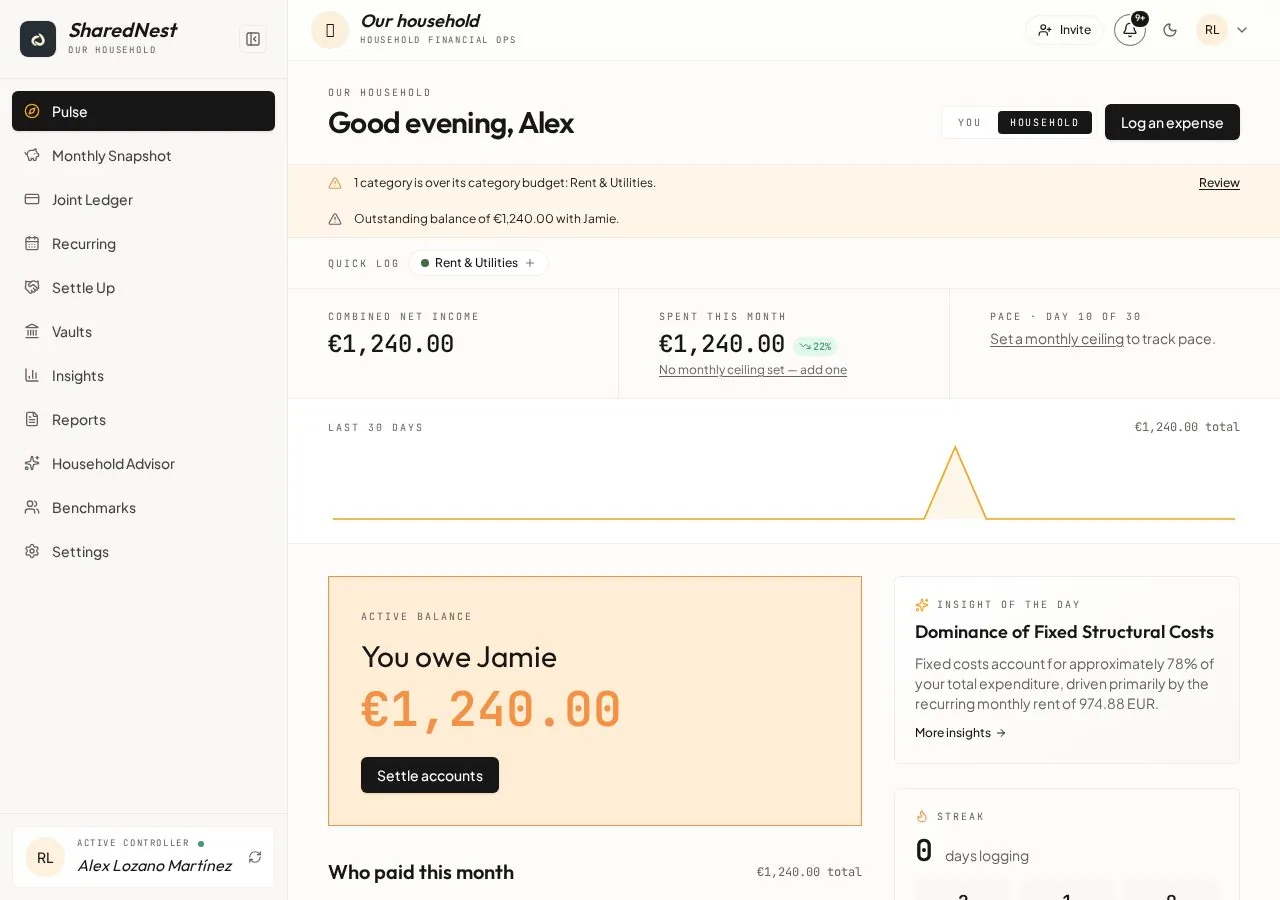
Pulse brings this month’s position, household balance and next actions into one calm view. Demo data shown.
In short
SharedNest gives a couple one shared ledger, splits every shared expense fairly — evenly, by income, or by custom shares — and keeps a live balance of who owes whom. Private purchases stay private, and each partner can switch to a You view to see only their own share.
What do couples usually argue about?
Rarely the total. Usually the sense that contributions are uneven, that one person is doing all the administration, or that a purchase was made without discussion. All three are visibility problems before they are money problems.
Once every shared cost has a share attached and both people can see it, most of the argument disappears — not because anyone won, but because there is nothing left to reconstruct from memory.
How should a couple split expenses?
If your incomes are similar, even splits are simple and fine. If they differ by more than about 20%, proportional splitting keeps the burden equal. Many couples split fixed costs by income and discretionary spending evenly.
Even, income-weighted, custom percentage or exact amounts
A different rule per expense when that is the honest answer
Private "stealth" expenses for gifts and personal purchases
One live balance instead of a running argument
Settle up in one action, partial settlements included
Do you need a joint account?
No. SharedNest works with two separate accounts, one joint account, or a hybrid where a joint account covers fixed bills and personal accounts cover everything else. It records who paid, whatever the plumbing.
What keeps you using it after week three?
Low friction and a reason to come back. Receipt scanning and mobile quick-add keep entry cheap; the Monday digest and the Monthly Snapshot give both people something worth reading.
A worked example: moving in together
Incomes of €2,800 and €2,000 net, shared costs of €1,900 a month.
Combined net income
€4,800
Split ratio
58% / 42%
Higher earner pays
€1,102
Lower earner pays
€798
Share of own income
39% each
Under 50/50
34% and 48%
The same €1,900 either feels balanced or lopsided depending only on the rule you pick. Deciding it once, together, is the whole point.
Spreadsheet, splitting app, or SharedNest?
How the three options behave over a year of living together.
Spreadsheet
Bill-splitting app
SharedNest
Fair splits by income
Manual
Uncommon
Built in
Private purchases
Visible to both
Visible to both
Kept private
Recurring bills
Re-entered
Partial
Projected forward
Personal view
Separate sheet
None
You / Household toggle
Weekly summary
None
None
Monday email digest
Questions people ask
Is SharedNest better than Splitwise for couples?
For couples, usually yes: Splitwise is built around an even-split running tab, while SharedNest adds income-weighted splitting, private expenses, recurring bills, budgets and a personal view. For a one-off group trip, a splitting app is lighter.
Can we hide surprises from each other?
Yes. Mark an expense private and it never appears in the shared ledger or balance, which is what makes birthdays possible.
What if one of us stops earning for a while?
Update the incomes and the ratio adjusts. During parental leave or a job change, proportional splitting is usually the setting that keeps things fair without a conversation every month.
Do both partners need an account?
Yes, each person signs in with their own account and joins the household by invitation, which is what keeps private expenses genuinely private.
How long does setup take?
About fifteen minutes: create the household, invite your partner, add recurring bills and set the split rule. Everything after that is a few taps a day.