
Does SharedNest connect to my bank?
No. Recurring bills are set up by you rather than imported, which keeps the app out of your banking credentials and lets you split each bill exactly how your household has agreed.
Features — Recurring bills
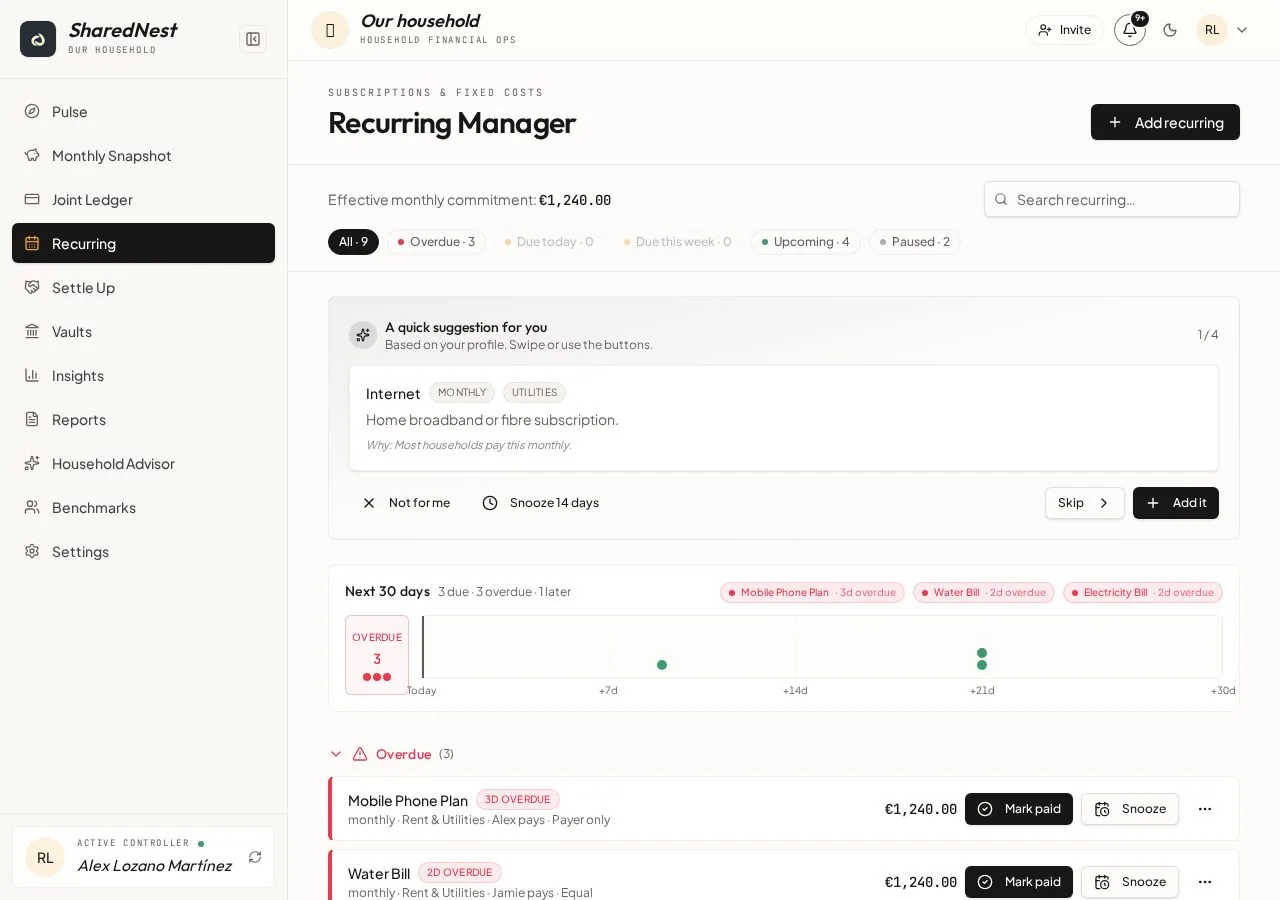
Most of a household budget is decided before the month starts. SharedNest projects every recurring bill forward so the fixed part of your month is visible in advance.
In short
Recurring bills in SharedNest are templates: an amount, a schedule, a category and a split rule. The app projects them forward so you can see what is due in the next seven and thirty days, and marking one paid drops it into the ledger already split the way you set it.
Rent or mortgage, utilities, internet and phone, insurance, childcare and school fees, gym memberships, streaming and software subscriptions, loan repayments — anything that arrives on a schedule.
SharedNest totals your recurring commitments and flags when that total grows. A €9 subscription is invisible on its own; eleven of them are €1,188 a year, and the recurring view is where that becomes obvious.
The weekly digest also highlights new or increased recurring charges, so a price rise gets noticed in the week it happens rather than at the end of the year.
It is the share of household income already committed before you spend anything discretionary. Below roughly 50% leaves real flexibility; above 70% means a single bad month hurts. SharedNest shows the ratio and how it changes.
Yes. Bills due in the next seven days appear in the weekly digest, and a daily reminder can notify the person responsible before the payment date, in the app or by email depending on your notification settings.
A two-adult household with €4,600 net income between them.
That leaves €2,477 for groceries, transport, saving and everything else — the number worth watching when you consider a new commitment.
No. Recurring bills are set up by you rather than imported, which keeps the app out of your banking credentials and lets you split each bill exactly how your household has agreed.
Set the usual amount and adjust the figure when you mark it paid. The ledger records what you actually paid, not the estimate.
Yes. Rent might be income-weighted while a shared streaming subscription is even. The split rule belongs to the bill.
Quarterly and annual bills are projected forward, so an insurance premium or a yearly software renewal does not arrive as a surprise.
It stays flagged as due and appears in reminders and the weekly digest until it is either marked paid or removed.
Free while we build — every feature included. Invite your partner and set up your household in under 5 minutes.